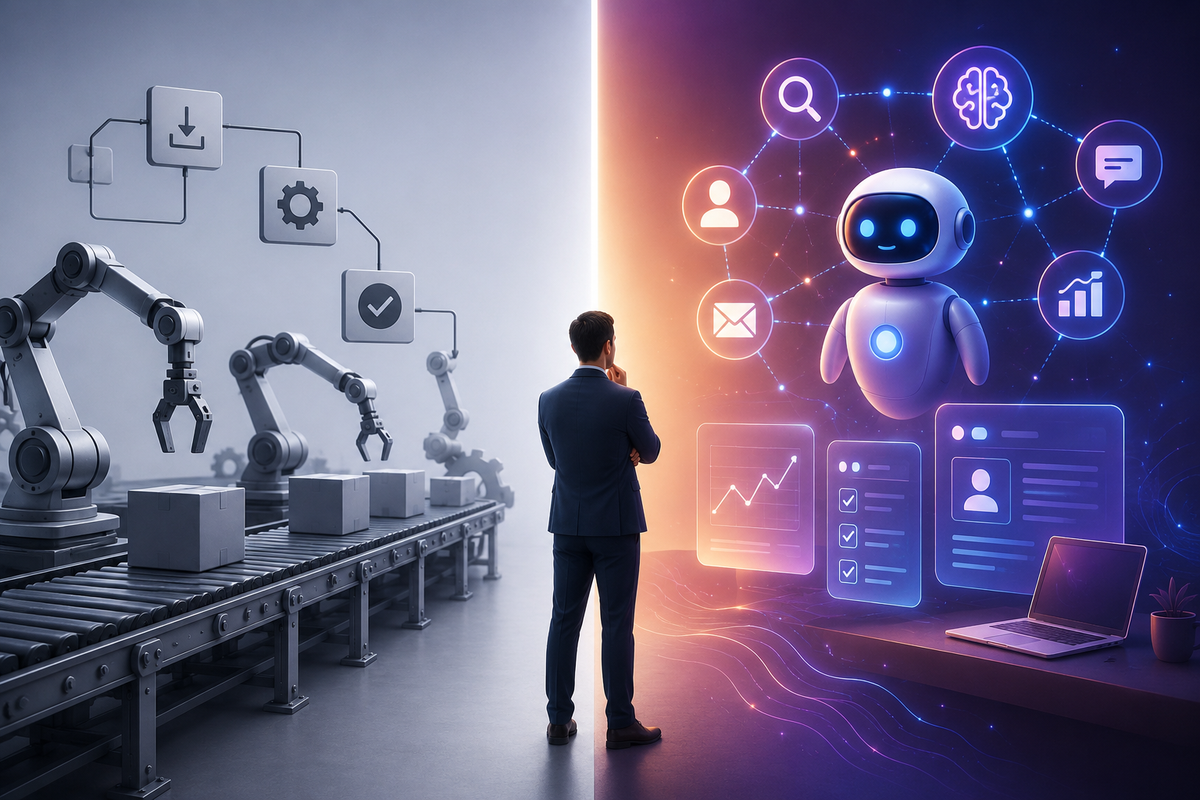
Artificial intelligence is everywhere. Businesses are hearing terms like AI Agents, Agentic AI, Workflow Automation, and Digital Transformation almost daily.
The challenge is that many business owners assume they all mean the same thing. They do not.
Understanding the difference between automation and AI agents can help you make better technology investments and avoid spending money on solutions that do not solve the right problem.
What Is Automation?
Automation follows predefined rules and processes. You tell the system exactly what to do, and it performs those actions repeatedly.
Examples include:
- Automatically sending an invoice when a sale is completed
- Creating a task when a customer submits a form
- Moving data from one system to another
- Sending reminder emails before an appointment
Automation is highly effective when the process is predictable and rarely changes. Think of automation as a train running on fixed tracks. It performs the same journey every time.
Benefits of Automation
- Fast implementation
- Lower cost
- Consistent execution
- Reduced manual effort
- Easy to monitor and audit
Limitations of Automation
- Cannot adapt to unexpected situations
- Requires predefined rules
- Struggles with complex decision making
- Needs manual updates when business processes change
For many SMEs, automation alone can eliminate hundreds of hours of repetitive work every year.
What Is an AI Agent?
An AI Agent is designed to achieve an outcome rather than simply follow instructions. Instead of being told exactly what steps to perform, the agent is given an objective and determines how to achieve it.
For example, a traditional automation might read an email, extract customer details, and create a support ticket. An AI Agent might read the email, understand the customer's problem, search company documentation, draft a response, escalate complex cases, and follow up if no response is received.
The key difference is that the agent can make decisions based on context. Think of an AI Agent as a capable employee rather than a machine following instructions.
What Is Agentic AI?
Agentic AI is the broader concept of multiple AI agents working together to achieve a goal. Instead of one agent handling a task, several specialised agents collaborate.
For example, in a sales process:
- Research Agent identifies prospects
- Outreach Agent drafts personalised emails
- Meeting Agent schedules appointments
- Analysis Agent reviews call transcripts
- Reporting Agent updates management dashboards
Each agent performs its own role while sharing information with other agents. This creates a system that can execute complex workflows with minimal human intervention.
Automation vs AI Agents
| Feature | Automation | AI Agent |
|---|---|---|
| Rule Based | Yes | Not necessarily |
| Handles Unexpected Situations | Limited | Strong |
| Learns Context | No | Yes |
| Makes Decisions | No | Yes |
| Complexity | Low to Medium | Medium to High |
| Cost | Lower | Higher |
| Best For | Repetitive Tasks | Knowledge Work |
Which Is Better for Your Business?
The answer depends on the problem you are trying to solve.
Choose Automation When:
- Processes are repetitive
- Rules are clear
- Data is structured
- Decisions are straightforward
Examples: Invoice processing, staff onboarding workflows, appointment reminders, data entry, report generation.
Choose AI Agents When:
- Human judgement is involved
- Information is unstructured
- Tasks vary frequently
- Multiple decisions must be made
Examples: Customer support, sales prospecting, financial analysis, compliance reviews, business research.
The Biggest Mistake Businesses Make
Many businesses try to implement AI Agents before fixing their processes. This often leads to disappointing results. If a process is broken, an AI Agent will simply execute a broken process faster.
Before investing in Agentic AI, businesses should first understand:
- Where manual work exists
- Which tasks are repetitive
- Where decisions are being made
- What outcomes are being measured
In many cases, automation delivers a quicker and more immediate return on investment.
The Best Approach: Automation First, Agents Second
The most successful organisations do not choose one or the other. They combine both.
- Stage 1: Process Audit. Identify inefficiencies and manual work.
- Stage 2: Automation. Automate repetitive and predictable tasks.
- Stage 3: AI Enhancement. Introduce AI for decision support and analysis.
- Stage 4: Agentic Workflows. Deploy AI Agents to manage complex business processes end-to-end.
This approach delivers faster wins while creating a foundation for more advanced AI adoption.
Final Thoughts
Automation and AI Agents are not competitors. They solve different problems. Automation is ideal for repetitive, rule-based work. AI Agents are ideal for dynamic, decision-driven work.
For most SMEs, the biggest opportunity is not replacing employees with AI. It is removing repetitive tasks so teams can focus on higher-value activities.
Businesses that understand when to use automation, when to use AI agents, and how to combine both will gain the greatest advantage over the next decade.
The question is not whether your business should use AI. The question is whether you are solving the right problem with the right technology.
Frequently asked questions
What is the difference between automation and an AI agent?
Automation follows predefined rules, while an AI agent works toward an outcome and decides the steps itself. Automation does the same thing every time, like sending an invoice when a sale completes. An agent can read an email, understand the problem, search documentation, draft a reply, escalate complex cases and follow up.
When should a business choose automation instead of an AI agent?
Choose automation when processes are repetitive, rules are clear, data is structured and decisions are straightforward. Good examples are invoice processing, staff onboarding workflows, appointment reminders, data entry and report generation. It is faster to implement, costs less and is easy to monitor and audit.
When is an AI agent the better choice?
Choose an AI agent when the work involves human judgement, unstructured information, tasks that vary often or several decisions in a row. Customer support, sales prospecting, financial analysis, compliance reviews and business research are typical examples, where fixed rules break down.
What is agentic AI?
Agentic AI is several specialised AI agents working together toward one goal while sharing information. In a sales process, for example, one agent identifies prospects, another drafts personalised emails, another schedules meetings, another reviews call transcripts and another updates management dashboards.
Should we start with automation or AI agents?
Start with automation, then add agents. The approach that works is a process audit first, then automating repetitive and predictable tasks, then adding AI for decision support, then deploying agents for complex end-to-end workflows. Adding agents to a broken process only runs the broken process faster.